

Technology & Trust
Purpose limitation, server-knowledge minimisation and encryption solve different privacy problems. Softa’s architecture brings them together without treating any one label as a complete answer.
The first privacy question is purpose: what information should the service use at all? The second is access: which actor or system should be able to see it? The third is protection: how is it secured at the relevant stage? A service can use encryption and still repurpose information inappropriately; it can minimise data and still need strong account security.
Softa’s constitutional approach addresses all three. It rejects unrestricted behavioural pooling, assigns separate product responsibilities and treats data and key access as engineering questions. The approach is meaningful only when the relevant implementation preserves those distinctions.

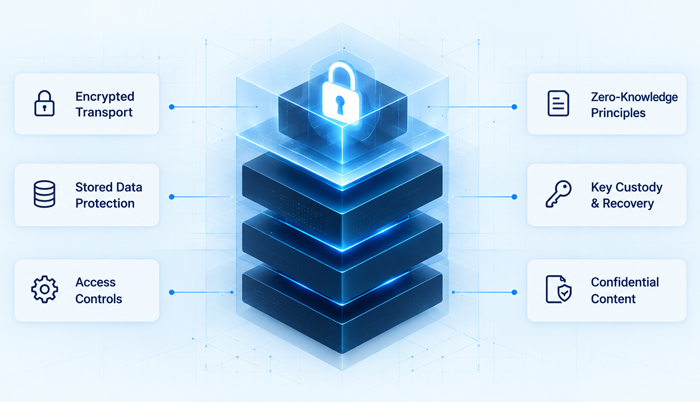
The company’s zero-knowledge server terminology concerns limiting institutional access to protected content. It is not a claim about mathematical zero-knowledge proofs, the absence of all metadata or universal anonymity. Devices, backups, key custody and recovery can change the protection offered by a specific feature.
An encrypted transport connection protects a different stage from end-to-end message content. Stored-data encryption protects another stage. A useful technical account identifies the actor able to decrypt, the protected data class and the conditions under which access can be restored or revoked.
Delivery, abuse prevention, support and security may require records. Their necessity does not automatically authorise unrelated advertising, profiling or training. The institutional architecture retains purpose restrictions across shared infrastructure and provider relationships.
For example, a communication delivery record is not a general permission to infer a person’s relationships for advertising. A business-support ticket is not an unrestricted source of employee training data. The task and rights that allowed information into the system continue to matter after collection.

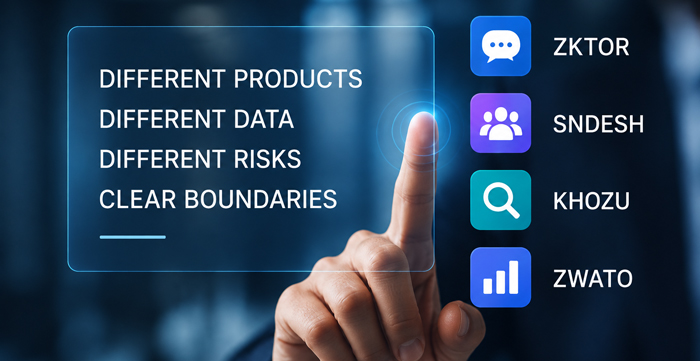
ZKTOR media, SNDESH conversations, KHOZU queries and ZWATO business records have different exposure risks. Their architectural privacy overviews therefore address different information and access boundaries. The applicable service notice and release define the operational scope.
This corporate architecture account is not an independent security assessment. Exact algorithms, provider retention and release-specific behaviour require their own supported disclosures; no missing implementation detail is filled with an assumed protocol or guarantee.
OUR PURPOSE
Softa is building a connected technology ecosystem around privacy, participation and practical human needs creating digital systems designed to remain useful, responsible and inclusive as they grow.
