


Strategic Self-Reliance
Know the system. Retain the choice.
Self-reliance is the ability to understand essential systems, operate them responsibly and adapt when a dependency changes. It is not a claim that every component must be rebuilt or every external relationship rejected.
Rights that support the work
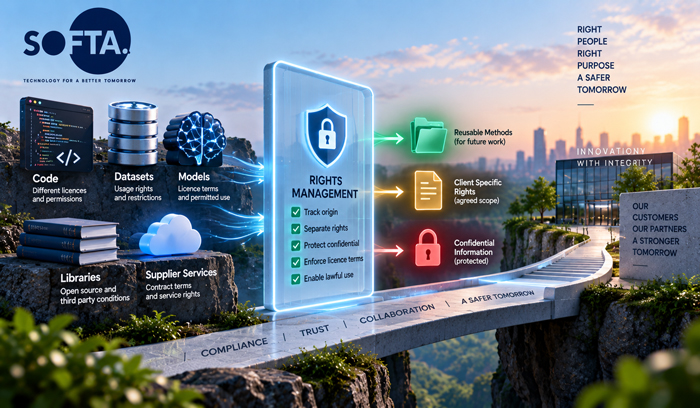
Code, datasets, models, libraries and supplier services carry different rights. Possession of a file does not establish ownership, redistribution rights or permission to transfer it to another entity. The institutional software-supply-chain framework therefore separates contribution history, licences, confidential material and the use permitted by a contract.
For an enterprise relationship, this distinction protects both the customer and Softa. Reusable methods can support future work, while client-specific rights and confidential information retain their agreed scope. A technical integration must not silently acquire rights its source never granted.

Knowledge that survives individual tenure
Documentation, cross-training and institutional custody connect expertise with continuity. A critical system dependent on one person’s account or memory is not made self-reliant by being developed locally. Repositories, signing identities, domains and recovery procedures need appropriate organisational control.
The objective is the capacity to maintain and improve useful systems through leadership or team changes. That includes understanding why a decision was made, which alternative was rejected and what boundary must remain intact during a repair or migration.
Replacement without loss of purpose
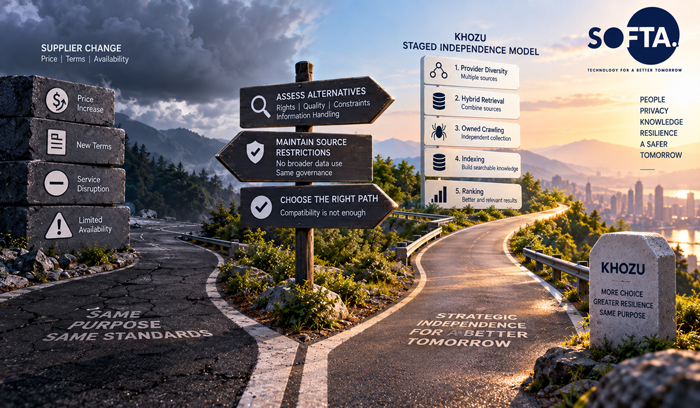
A supplier’s price, terms or availability can change. A credible alternative must be assessed for rights, quality, operating constraints and information handling—not just technical compatibility. The same source restrictions must survive a new model or infrastructure route.
KHOZU’s staged independence model illustrates this distinction. Provider diversity, hybrid retrieval, owned crawling, indexing and ranking are separate capabilities. Each can improve strategic choice in a different way; naming the stages does not mean all have already been achieved.
The financial and local dimensions
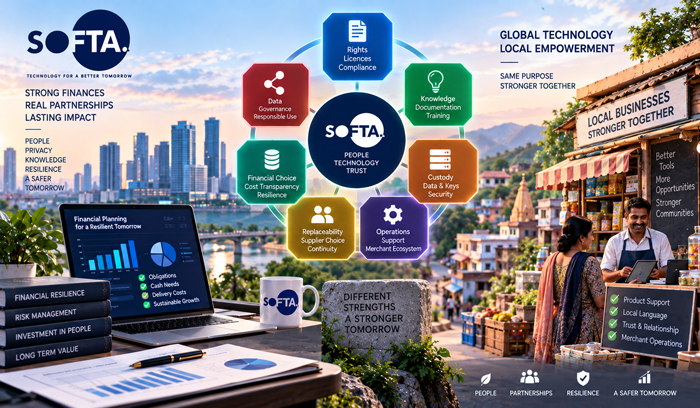
Financial resilience requires an account of obligations, cash needs and full delivery costs. Local expertise requires a real relationship with product support, language quality, trust work and merchant operations. Neither can be replaced by a purely national-origin claim.
Softa’s framework brings these dimensions together: rights, knowledge, custody, operations, replaceability, data and keys, financial choice and continuity. Their purpose is a service that can remain useful and responsible when important circumstances change.